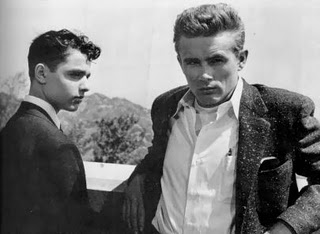
It's not just the leather jacket. People forget that the rest of Dean's wardrobe in Rebel was more Wittgenstein than The Wild Ones. Sal Mineo's wardrobe (along with his performance) has also been forgotten. What's really surprising about the wardrobe for these "rebellious" teenagers is it's sense of restraint. This isn't Brando on a motorcycle with a gang of similarly dressed troublemakers. These are real kids, wearing what is pretty much acceptable for the day and only slighlty pushing the boundaries. The ultimate rebel wears a tweed jacket, not a leather one.Rebel Without A Cause - 1959
It's not just the leather jacket. People forget that the rest of Dean's wardrobe in Rebel was more Wittgenstein than The Wild Ones. Sal Mineo's wardrobe (along with his performance) has also been forgotten. What's really surprising about the wardrobe for these "rebellious" teenagers is it's sense of restraint. This isn't Brando on a motorcycle with a gang of similarly dressed troublemakers. These are real kids, wearing what is pretty much acceptable for the day and only slighlty pushing the boundaries. The ultimate rebel wears a tweed jacket, not a leather one.Some Liket It Hot - 1959
It wasn't enough that Marilyn Monroe would be frolicking around in a sheer, sequined, skin tight dress. The costumes for Jack Lemmon and Tony Curtis in drag were every bit as fabulous as Marilyn's. In fact, Marilyn looks out of place in the roaring twenties, her curves being in serious conflict with the era's ideal. It's the negotiation of twenties and fifties styles, believability and comedy, that make the clothes in this film brilliant beyond comparison.
Breakfast at Tiffany's - 1961
This is, hands down, the least controversial film on the list. But I'd like to reject the way the film is normally invoked. If Holly Golightly were just glamorous, the clothes would be dull. What is special about the character and her famous scene in front of the window at Tiffany's is the performance of glamour. Holly is playing at being rich and glamorous, dreaming of one day affording the jewels in the window. What is, or should be, inspiring about the fashion in the film is our ability to play around with our clothes, take on an alter ego, have fun. Not that we should lie to the hot homosexual living in the apartment building, but you know what I mean.
Cleopatra - 1963
There are two reasons to watch Cleopatra. To hear Elizabeth Taylor explain the value of a library to Caesar, and to see how many ways Irene Sharaff can emphasize Taylor's bosom. And it's quite a bosom. But with 65 costume changes, the record for motion pictures, it's not just about low-cut. Scene after scene shows Taylor in yet another fabulous get-up, dressed (or undressed) to perfection for the given situation.
Bonnie and Clyde - 1967
Faye Dunaway in Bonnie and Clyde would be the best dressed hipster at your local indie coffee house. That's how of-the-moment the clothing is. For whatever reason, the thirties-cum-sixties style is very trendy on the runways right now, leading all of us to ask whether it wouldn't be better to say you're going for the Faye Dunaway, rather than the thrities-cum-sixties-cum-two-thousands.
Cabaret - 1972
Fosse, a polyamourous relationship, Nazis, and spectacular stage perfromances - does it get any better than Cabaret? The clothing in this film captures the pre-war Berlin of Christopher Isherwood's imagination and experience, an era that seeemed oddly appropriate to the early seventies. While no one could doubt the influence of Liza Minelli's outfits, my attention is always turning to the costumes, literally meant to be costumes, that appear on stage. The Cabaret girls are sexy, but also grotesque, the drag is comically off-base, and the master of ceremonies looks the part of a Shakespearean clown.
The Sting - 1973
What's with the seventies and fashion from the twenties and thirties? Another thesis paper waiting to happen. But, again, costume designers got it right with The Sting, making Reford and Newman look just as sexy as ever. The greatest part of the costuming, however, is the wide variety. These are con-men, so their character and clothing have to change for each con they play. The result is a rich documentation of men's clothing - the cuts, the colors, the patterns, the lines.
Subscribe to:
Posts (Atom)